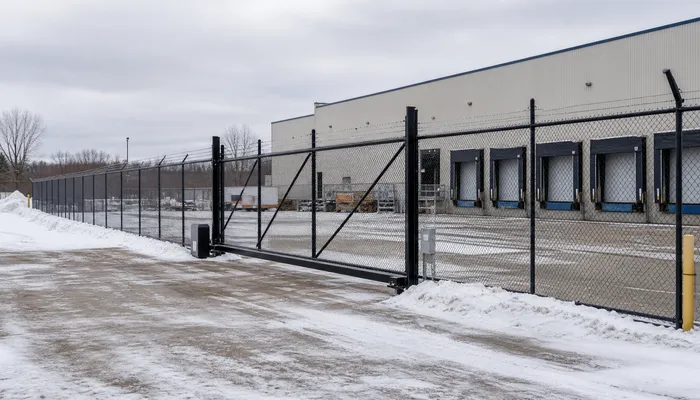

Commercial fence lines around Chicago rarely fail all at once. They fail post by post, season after season. The forces that affect commercial fence lifespan in this region are mostly invisible from the cab of a truck: meltwater working into post footings, frost lifting soil around base plates, road salt chewing at a coating, and snow pressed against panels for weeks at a time. For property managers across Cook County, understanding those forces is the difference between a perimeter that ages gradually and one that arrives at replacement years earlier than it should.
What follows is a practical look at how a Chicago-area winter works on commercial fencing, how the pattern plays out from the lakefront suburbs to the western edge of Cook County, and which maintenance and planning habits genuinely extend service life.
How Freeze-Thaw Cycles Affect Commercial Fence Lifespan
Water enters the soil around a post in the fall. When temperatures drop, that moisture expands as it freezes, then contracts and settles as it thaws. Repeated dozens of times in one season, the cycle slowly loosens the ground holding a post plumb. A line that measures straight in November can lean noticeably by March, and a swing or slide gate hung on a shifted post stops latching cleanly.
Footings set below the frost line limit that movement, but they do not remove it. What happens around the footing matters most: whether the base drains, whether backfill was compacted, and whether the post was set in concrete, gravel or packed soil. Perimeter runs that sit in low spots, below downspouts, or along a grade that pushes meltwater toward the posts tend to show winter damage first.
What Salt, Snow Load and Wind Add to the Damage
Frost movement is the slowest of the winter problems. The faster ones arrive from above and beside the fence:
- Road salt and brine. Plow trucks throw salt and spray well past the curb line. It collects on bottom rails, base plates and gate tracks, accelerating corrosion on galvanized and painted steel long before the panels themselves show wear.
- Piled snow. Plowed or shoveled snowbanks hold moisture against the bottom third of a fence for weeks. Wood wicks that water into end grain, and any coating that has already been nicked lets it underneath.
- Wind and ice. Solid privacy panels, windscreens, banners and signage all act as sails. Gusts against a large surface stress post-to-rail connections and the anchors at the base.
- Gate hardware. Rollers, hinges, tracks, latches and operators are the most mechanically active parts of a commercial perimeter, and they are the first components to feel moisture and hard freezes.
Why Materials and Maintenance Affect Commercial Fence Lifespan
Material choice sets a ceiling on durability; installation and upkeep decide how close a fence line gets to it. Two fences built to the same specification can behave very differently depending on coating quality, fastener selection and how well the base drains.
| Material | Winter Pressure Point | Typical Fit |
|---|---|---|
| Wrought iron and steel | Coating chips and delayed touch-up; corrosion at welds | Storefronts, gates, visible perimeters |
| Chain link | Coating wear near the bottom rail and gate frame | Lots, yards, service and storage areas |
| Vinyl | Impact behavior in deep cold; soil movement at posts | Low-maintenance screening runs |
| Wood | Moisture wicking, swelling and freeze damage at the base | Privacy screening and buffer fencing |
| Composite | Panel movement and fastener loosening | Long screening runs with minimal upkeep |
None of these materials is maintenance-free in this climate. The realistic goal is matching the material to how the property is used and how much upkeep the owner is prepared to schedule.
Why the Same Winter Hits Each Community Differently
The scale is regional before it is local. Illinois has an estimated population of about 12.7 million, and its largest city, Chicago, anchors a commercial corridor that runs north along Lake Michigan and west across Cook County. The state stretches from the lakefront to the Mississippi River, but the properties in this guide share one set of winter conditions: the freeze-thaw pattern that dominates northeastern Illinois.
Exposure then shifts from one commercial district to the next. A lakefront commercial property in Evanston deals with wind-driven snow and salt spray, which pushes corrosion toward the lower rails faster than inland sites see. Compact inner-suburb parcels, where a service yard sits a few feet from a building wall, collect more plowed snow against panels and get less airflow to dry them out. Longer industrial and warehouse runs let wind move uninterrupted across a fence line, which magnifies any weak post.
Cook County population estimates from the ACS five-year data place Evanston at roughly 76,552 residents, Lincolnwood at about 13,179, Morton Grove near 24,687, and Oak Park around 53,315. Commercial districts roughly follow those numbers: dense storefront blocks and small parking lots in one place, wider storage lots and light industrial parcels in another. Property managers searching for iron fence installation in Evanston, IL usually care about entry points, gates and street-facing appearance. Priorities shift for owners comparing fence contractors serving Lincolnwood, IL, where tight parcels put a premium on accurate layout and clean gate swings. Larger sites call for different thinking again, whether that means wood fence installation in Morton Grove, IL for screening or commercial fencing in Oak Park, IL where zoning shape and street presence carry real weight.
Preventive Maintenance Before and After the Freezing Season
A short inspection routine costs far less than premature replacement. Two passes a year, one before the first hard freeze and one as the ground thaws, catch most of the damage while it is still inexpensive to correct.
- Walk the full line in late fall. Look for posts that are already out of plumb, loose rails and fasteners that have backed out.
- Clear soil, mulch and debris away from the base of each post so water can drain instead of pooling against the metal or wood.
- Test every gate by hand. Binding, dragging or a latch that no longer lines up usually points to a shifted post rather than a worn hinge.
- Touch up nicked coatings before winter. A small spot of exposed steel in November becomes a corrosion pocket by spring.
- Repeat the walk in early spring, while the ground is soft and before snowbanks finish melting into the posts.
For a fuller look at scheduled upkeep between seasons, keeping a commercial fence in top shape walks through the routine in more detail.
Repair or Replace After a Hard Winter
Not every leaned panel means replacement. The decision usually comes down to four questions: how many posts have moved, whether the movement is isolated or spread across a long run, whether the footings are sitting in wet soil, and whether the coating or finish has reached the end of its useful life. Localized damage with sound footings is normally a repair. Widespread corrosion, rotted wood at the base or several footings that have pushed out of line usually point toward replacement, because the next winter will simply repeat the damage on a larger scale.
Permits, Codes and Utility Locates Across the Region
Fence rules in Illinois are set municipality by municipality, not by county, so a plan that clears one village may need adjusting in the next. Oak Park is a useful reference point rather than a regional standard. The village requires a permit application to install or modify a fence, and its zoning ordinance sets non-residential fence height limits that depend on how close a fence sits to the front lot line, with an open-fence requirement and a 5-foot cap in certain front-area conditions and an 8-foot maximum elsewhere. The same ordinance treats fence height as including gates and appurtenances, prohibits chain-link and open-wire fencing in front yards and in the forward portion of corner side yards, bars barbed wire, electric fencing and pointed instruments on top of fences, and requires fences to be kept rust-free with posts maintained vertically. Those provisions are published in the Village of Oak Park zoning ordinance, and every other community in the area maintains its own version. This summary is planning information rather than legal advice, so confirm current requirements with the specific municipality before ordering material. For the wider project picture, the essentials of commercial property fence construction explains how design, approval and installation fit together.
Digging is regulated separately from fencing. In Illinois outside the City of Chicago, post excavation falls under the JULIE notification service at 811, which asks anyone planning an outdoor digging project to submit a locate request before work starts, regardless of depth or project size. Utility locates are a normal step in commercial fence installation and should never be skipped because a post hole looks shallow.
Frequently Asked Questions
What Affects Commercial Fence Lifespan the Most in This Climate?
Freeze-thaw movement at the posts does more to affect commercial fence lifespan than any single product choice. Moisture in the soil expands and contracts repeatedly through the winter, and salt exposure, drainage at the base, coating condition and gate hardware all compound the effect. A fence with deep, well-drained footings and intact coatings consistently outlasts an identical fence installed on the same block with shallow or poorly drained posts.
Which Commercial Fence Material Lasts Longest Around Chicago?
There is no single winner, because exposure and upkeep matter as much as material. Powder-coated steel and galvanized or vinyl-coated chain link hold up well when corrosion is managed, while wood and composite generally need more attention at ground level. The right answer depends on how much wind the site takes, how much salt it sees and how much maintenance the property can schedule.
Do Commercial Fence Projects in These Villages Need a Permit?
Usually, yes. Most Illinois municipalities require approval to install or modify a fence, and the details rarely match a neighboring town’s. Oak Park, for example, requires a permit application to install or modify a fence and restricts chain-link and open-wire fencing near the front lot line. Confirm current requirements with the specific village or city before ordering material.
Can a Winter-Damaged Fence Be Repaired Instead of Replaced?
Often it can. When movement is limited to a few posts and the surrounding footings are sound, resetting or replacing those posts usually restores the line and the gate alignment. Replacement makes more sense when several posts have shifted, wood has rotted at the base, or corrosion has reached structural components rather than just the finish.
When Is the Best Time of Year to Install or Replace a Commercial Fence Line?
Late spring through fall is the easiest window for excavation, concrete curing and coating work. Installation is possible in winter, but frozen ground slows digging and low temperatures affect curing times, so schedules and costs change. Planning a replacement during winter for a spring installation is often the most efficient approach.
Planning the Next Commercial Fence Line
Winter damage rarely announces itself until a gate stops closing or a post is visibly out of line. Walking the property before the ground freezes, then again as it thaws, gives a property manager time to plan repairs on a schedule instead of reacting to a failure.
Osceola Fence & Security works on commercial, industrial and multi-unit properties across Chicago and the surrounding suburbs, with more than 50 years of fencing and ironwork experience, in-house fabrication of gates and ornamental ironwork, help preparing permit submittals, and a 1 Year Certified Craftsmanship Guarantee™ on qualifying projects. For commercial and industrial work, call the commercial line at (773) 417-3107 or request a commercial site visit. Financing through the GreenSky® Loan Program may be available for qualified customers; financing is subject to credit approval and applicable GreenSky® terms and conditions.
If the property sits in Evanston, Lincolnwood, Morton Grove or Oak Park, the individual city pages cover material options, gate work and service details for that community.