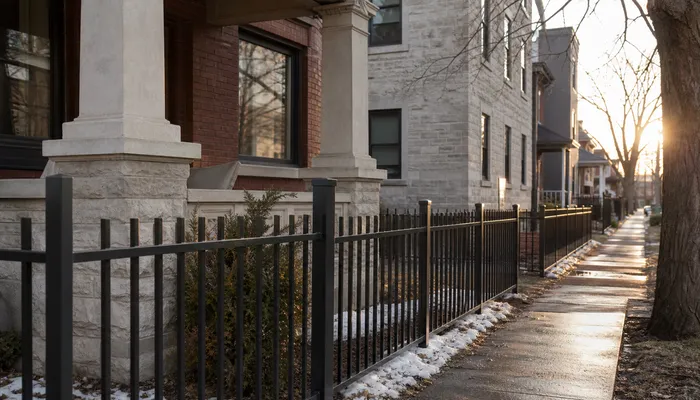

On a brick-lined block in Chicago, a homeowner steps back from the sidewalk to study a narrow side yard. The bungalow’s limestone porch and the greystone next door frame a strip of concrete barely wide enough for two people to pass. The question is not whether to add a fence, but how to add one that looks like it belongs. That is where steel fencing for bungalows and greystones becomes less about a product and more about proportion, finish, and respect for the original facade.
Chicago’s older residential blocks—particularly the bungalow belt and the greystone rows—were built with specific rhythms: shallow front setbacks, shared side gangways, and facades that carry their own architectural weight. Adding a fence to these properties is different from fencing a new suburban lot. The fence has to work with the house, not against it. City profiles such as Census Reporter’s Chicago city profile remind us that this is a dense, varied housing market where one solution rarely fits all.
Why Older Chicago Blocks Ask Different Questions of a Fence
The first thing a fence installer notices on these blocks is the width of the lot. Many Chicago bungalows sit on 25- or 30-foot-wide lots. That leaves a side gangway that may be only three or four feet across. A fence line there cannot simply be copied from a neighbor’s front yard. It has to be measured to the inch, and it has to account for the way people actually move through the space—bringing in groceries, rolling out a trash bin, or clearing snow.
Facade proportions matter just as much. A bungalow’s low roofline and wide porch create a horizontal emphasis. A greystone’s tall, narrow front and limestone details create a vertical one. In both cases, a fence that is too tall or too heavy can overpower the house. Homeowners often ask about closing the front, the side, or the backyard. Each choice changes the visual balance. A front yard fence on a bungalow, for example, might need a lower profile to keep the porch visible. A side-yard line might be taller to define the property edge without hiding the brickwork.
For more on how narrow lots and gangways change a fence layout, the article how narrow lots and gangways change a fence layout is a useful companion read.
Steel Fencing Details That Respect a Historic Facade
Steel fencing works well on older Chicago blocks because it can be made slender. Thin pickets and narrow rails allow the fence to read as a delicate line rather than a wall. Picket spacing is a key design decision. A tighter spacing feels more solid and private; a wider spacing feels more open and airy. On a greystone, a slightly wider spacing can let the limestone base show through. On a bungalow, a mid-range spacing often balances privacy with the need to keep the porch and front steps visible.
Finish is another detail that separates a good match from a jarring one. A matte black or textured black finish tends to sit quietly against red brick and gray limestone. Glossy finishes can reflect light and draw attention to the fence itself, which is rarely the goal on a historic block. Powder-coated steel in a low-sheen black is a common choice for this reason. If the home has wrought-iron details—common on some greystones and bungalow porches—a steel fence can echo those curves or simple vertical lines without trying to imitate them exactly.
Alignment is the third detail. Fence lines on older lots often follow the edge of a concrete walk, the base of a limestone step, or the line of a porch pillar. Getting that alignment right takes an on-site eye. A fence that sits two inches off from the step line can look accidental; a fence that follows it looks intentional. Low-profile steel fence styles help here, because they do not demand a lot of visual space. They simply trace the existing geometry of the property.
If you are still weighing style options, fence styles that balance security and curb appeal offers a broader look at how different designs shape the front of a home.
Living With Steel Through a Chicago Winter on an Older Lot
Chicago winters are hard on everything outdoors. Lake-effect snow, sidewalk salt, and repeated freeze-thaw cycles test the best materials. Steel fencing is not immune to these conditions, but its performance depends heavily on how it is installed. The base of each post is the critical point. If posts are set in concrete that drains poorly, or if the fence line sits in a low spot where meltwater pools, the finish can degrade faster. On an older lot, drainage patterns are often uneven. A sloped walkway or a settled gangway can direct water toward the fence line without anyone noticing until winter.
Salt is another factor. De-icing salt used on sidewalks and driveways can splash onto the lower rails and pickets. A powder-coated finish resists this better than a bare or thinly painted surface, but it is still worth rinsing the fence line in spring if salt exposure is heavy. Homeowners on tight city lots should also check for snow piled against the fence. Heavy, wet snow can bend thinner pickets if it is packed and left for weeks. A quick clearing after major storms is a simple habit that protects the fence’s shape.
Seasonal checks are straightforward. Look for loose post caps, any signs of rust at weld points or scratches, and gates that no longer swing cleanly. Small adjustments early can prevent bigger repairs later. If an older fence line is already showing its age, it may be worth asking when an older fence line is worth repairing rather than replacing.
Next Step for Homeowners on Tight City Lots
Before requesting a visit, take a few minutes to measure and photograph. Measure the width of the side gangway at its narrowest point, the distance from the house to the property line, and the height of any existing steps or porch edges. Photograph the facade from the sidewalk and from inside the yard. These details help an estimator understand the constraints before arriving on site. They also speed up the conversation about picket spacing, height, and finish.
On-site measurement is not a formality. A fence that is fabricated from rough dimensions can end up needing adjustments in the field, which adds cost and time. A careful measurement confirms the exact post locations, gate swing, and any slope changes along the line. It also reveals things that photos miss—like a hidden downspout, an uneven walk, or a utility meter that the fence needs to work around. That is why steel fencing built for Chicago’s older homes starts with a visit, not a catalog.
When you are ready, request a no-obligation estimate. The goal is a fence line that looks like it has always been there—quiet, well-proportioned, and suited to the block. On a bungalow belt street or a greystone row, that is the standard worth aiming for.