Skip to content

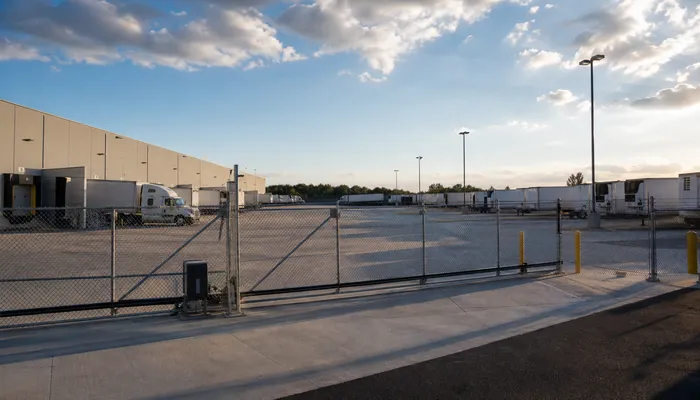
A commercial fence company near O’Hare works in a market that looks nothing like a residential subdivision. The airport corridor is a dense working landscape of warehouses, truck courts, loading docks, contractor yards, cold storage buildings, and small industrial parcels pressed up against residential blocks. A fence here has to define a property line, funnel traffic toward one controlled entrance, keep the yard visible after dark, and stand up to plow trucks, road salt, and steady wind. That is a different brief than privacy fencing around a backyard, and it shapes every commercial project planned in this corner of Cook County.
Why The O’Hare Corridor Drives Demand For Security Fencing
Illinois is a freight state before it is anything else. With an estimated 12.69 million residents, it carries the sixth-largest population in the country, and Chicago anchors the largest metropolitan economy in the Midwest, according to Census Reporter’s Illinois profile and the general Illinois overview on Wikipedia. That economy moves on trucks, and a large share of those trucks pass through, stage, or reload near O’Hare International Airport.
The villages that ring the airport host a heavy concentration of distribution buildings, truck terminals, contractor storage lots, and light manufacturing. Demand for perimeter fencing in this area does not come from curb appeal. It comes from operations: separating customer parking from fleet parking, keeping trailers out of fire lanes, screening stored material from the street, and giving a dispatcher one place to check in every vehicle that enters.
What Warehouse And Yard Fencing Has To Do In Practice
Every commercial perimeter answers three questions: who gets in, what can be seen, and how hard is it to climb. Material choice follows from those answers rather than from a catalog page. The commercial fencing solutions used on warehouse and yard projects usually combine two or three systems on a single site.
Chain Link Fences For Yards, Docks, And Service Lanes
Chain link remains the workhorse around loading areas because it is climb-resistant enough to slow an intruder, open enough to keep the yard watchable from the office, and sturdy enough to survive gate hardware and repeated trailer contact. Height, gauge, and post spacing should follow the exposure of the property rather than a default number, and corner bracing matters far more on a windy freight lot than on a sheltered backyard run.
Iron And Steel Fencing For Entrances And Street Frontage
Where a facility faces a public street, owners often want something more substantial than fabric and top rail. Iron and steel picket fencing with masonry or steel posts gives an entrance presence that reads as permanent, and it pairs well with ornamental detail on gates and pedestrian openings. Visibility through the fence is a design choice rather than a side effect, which is why visibility in commercial fence design comes up early in planning.
Automatic Security Gates And Access Control
Most theft and unauthorized entry on a commercial site happens through the driveway, not over the fence line. An automatic sliding or cantilever gate lets a yard run on one controlled opening, with a motor sized to the gate weight and the number of cycles it will see each day. Access control is what turns that gate into a record: who arrived, when, and which employee opened it. Industrial sites near the airport frequently run high cycles from early morning to late evening, so operator sizing and hardware quality matter as much as the gate itself.
Vinyl, Composite, And Wood For Screening And Mixed-Use Sites
Not every commercial property is a bare gravel yard. Mixed-use buildings, self-storage facilities, and properties with residential neighbors often need opaque screening rather than an open security line. Composite and vinyl offer low maintenance in a corridor that sees road salt and freeze-thaw cycles every winter, while wood remains an option where a warmer look is preferred and upkeep is manageable.
City By City Along The O’Hare Corridor
Property owners searching for a commercial fence company near O’Hare usually start with their own village, and that is the right instinct. Permits, setback expectations, and the mix of building types change from one municipality to the next, even when the fence design is nearly identical.
Des Plaines sits in Maine Township just north of the airport, with an estimated 59,408 residents according to ACS 5-year 2023 figures, and it carries a blend of industrial frontage along the river corridor and older residential blocks that back up to it. Projects here often involve replacing tired yard fencing and adding a controlled entrance, and the local coverage for commercial fencing in Des Plaines, IL explains how those two needs are handled together.
Niles borders Chicago’s far northwest side and mixes retail, medical, and warehouse properties with established neighborhoods. With an estimated 30,262 residents, it is dense enough that screening requirements sometimes matter as much as security line height. Local details for security fencing in Niles, IL cover the village permit process in more depth.
Schiller Park is small in area but heavy in freight activity, with an estimated 11,454 residents and tight parcels that leave little room for error on gate swing or truck turning radius. On lots that constrained, a sliding gate on an enclosed track usually beats a swing gate, and the regional page for chain link fencing in Schiller Park, IL walks through the layout questions that come up most often.
Old Norwood Park sits within Chicago’s Norwood Park community area on the far northwest side, where commercial frontage meets residential streets and alley access. Properties there tend to need a gate and access solution that looks deliberate from the street rather than a raw industrial line. The details for automatic security gates for Old Norwood Park, IL cover that balance.
Property owners in Franklin Park, IL also fall inside this same corridor. The village, with an estimated 18,233 residents in Leyden Township, is dominated by industrial and logistics uses with a residential core nearby, which means screening and sound-adjacent planning often come up alongside pure security work.
Permits, Inspections, And Utility Locating Before You Dig
Fence rules in this part of Illinois are municipal, not regional. A six-foot rear fence in one village can require a different submittal than the same fence one town over, and a commercial buffer yard can carry screening obligations that never apply to a homeowner. Treat any rule you read online as planning information and confirm it with the municipality that has jurisdiction over the property.
Niles is a useful example of how detailed the process can get. The Village lists fences as a separate permit category with its own condition sheet, and the Village of Niles fence permit information calls for a plat of survey, a property owner affidavit, a labeled plat showing the proposed fence location, signed fence conditions, and a contract or scope of work. The same handout describes post-hole and final inspections, with the post-hole inspection occurring before concrete or other material is installed, and states that post holes must be 42 inches deep. It also addresses finished-side orientation toward the neighbor, a two-inch ground clearance for solid wood fences running perpendicular within a drainage easement, sight-line limits near intersections and driveway approaches, and prohibitions on fencing over a sewer cover or within the public right-of-way.
Non-residential sites carry an additional layer. Niles requires buffer yards where a non-residential district abuts a residential district, with a ten-foot minimum width and, unless another use standard applies, a solid fence or wall six feet high running the full length of the buffer. The Niles landscape and buffer yard ordinance holds the current text and is the right place to verify screening requirements on a new commercial build.
Before any post hole is opened anywhere in Illinois, utility locating comes first. JULIE Illinois 811 is the state’s free locate service, and a locate ticket is a basic planning step on any excavation, including a simple fence line. Missing that step is one of the few fence mistakes that can turn a straightforward project into a serious one.
Choosing A Commercial Fence Company Near O’Hare
Osceola Fence & Security Corp has worked on Chicago-area fences, gates, and ironwork for more than 50 years. Custom iron gates, railings, and ornamental work are fabricated in-house by our own team, which matters on commercial jobs where a gate has to match an existing motif, a specific opening width, and the weight a motor will actually pull. We help owners prepare permit submittals, we are licensed and insured, and qualifying projects are backed by our 1 Year Certified Craftsmanship Guarantee™.
Perimeter work is often a capital line item rather than a repair, so financing through the GreenSky® Loan Program is available to qualified customers, with a simple application, a fast credit decision, multiple financing options, and no prepayment penalty. Financing is subject to credit approval and applicable GreenSky® terms and conditions. The basics of commercial property fence construction are also worth reviewing before a project goes out to bid.
For commercial and industrial proposals, call +1 773-417-3107. Residential fence and gate questions go to +1 773-278-4762, Monday through Friday, 8:00 AM to 4:00 PM.
Frequently Asked Questions
Does A Warehouse Fence Project Need A Permit In Every Corridor City?
Assume it does until the village says otherwise. Some municipalities treat fencing as a standalone permit with its own condition sheet, others fold it into a broader site review, and commercial buffer or screening requirements can apply on top of the fence permit itself. Confirm the current process with the building or community development department before scheduling installation.
Is Chain Link Still The Right Choice For A Distribution Yard?
For most working yards, yes. It is cost-effective at long linear footage, it keeps the interior visible for cameras and staff, and it handles gate hardware and trailer contact better than most decorative systems. The variables that matter are height, wire gauge, post spacing, and corner bracing rather than the material itself.
How Do Automatic Gates Change A Perimeter Plan?
They change it more than any other component. One controlled opening means the fence line can stay closed, camera coverage can focus on a single approach, and access records become possible. The trade-off is that the gate becomes the busiest piece of equipment on the site, so operator sizing, safety sensors, and a maintenance schedule matter from day one.
What Role Does Utility Locating Play Before Fence Installation?
A significant one on any excavation, including post holes. JULIE Illinois 811 coordinates the free locate process in this state, and a locate ticket should be part of the project schedule rather than a last-minute phone call on the morning the crew arrives.
Does A Fence Alone Secure A Commercial Property?
A fence improves perimeter definition, access control, and visibility management, but no fence, gate, or camera system prevents every incident. Most commercial sites get the best results from a layered approach: a solid perimeter, one controlled entrance, lighting, and camera coverage that complements the physical barrier.
If your property sits in Niles, Des Plaines, Schiller Park, Franklin Park, or the Norwood Park side of Chicago, the most useful next step is to look at the city page for your community and then walk the fence line with someone who knows how the local review process works. A site visit is the fastest way to turn a perimeter problem into a scoped, permit-ready plan.