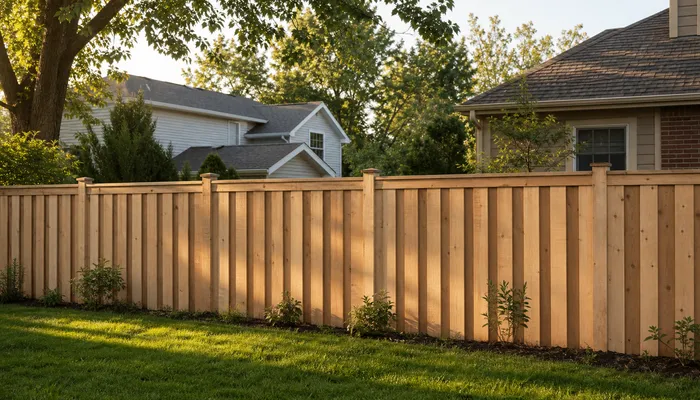

A good neighbor fence is one of those quiet solutions that makes an old suburban lot work better. Instead of giving one homeowner a finished view and the other the back of the boards, the fence is built so both sides look intentional. In Illinois, where many properties in the Chicago metro were platted long before anyone thought about privacy screens, that fair-to-both-sides approach solves a real problem. It also happens to look tidy from the street, the alley and the patio. The style is especially common in west suburban communities such as Hinsdale, Brookfield, Addison and Melrose Park, where lot lines are shared, mature trees crowd the property edge and neighbors tend to notice what happens on the other side of the fence.
Illinois is a large state — the U.S. Census Bureau’s ACS 5-year 2023 estimate puts the population at about 12.69 million — but fence decisions are local. A design that fits a new subdivision lot may feel out of place on an older village block. That is why the good neighbor fence is best understood as a family of construction details, not a single product. Census Reporter’s Illinois profile is a useful starting point for state-level context; the practical decisions still come down to the lot, the survey and the conversation with the person on the other side of the line.
What Makes a Good Neighbor Fence Different
The defining feature is the way the panels are built. In a traditional privacy fence, one side shows the finished face and the other shows rails and posts. A good neighbor fence alternates panel sections or uses a board-on-board construction so each property sees a complete, finished-looking surface. The fence still has posts, rails and fasteners, but they are arranged so neither neighbor feels like they got the ‘back’ of the project.
That detail matters more than it sounds. It reduces the awkwardness of asking a neighbor to share the cost of a fence that only looks good from one direction. It also gives both properties a cleaner view from windows, decks and patios. The good neighbor fence style is not a legal requirement in most places; it is a practical, social and visual choice that tends to make shared fence lines easier to live with.
Why the Style Fits West Suburban Lots
The Chicago metro has a wide mix of lot shapes. Some blocks have deep backyards and alleys; others have compact side yards where a fence is almost a wall between homes. In Hinsdale, established residential blocks often reward a fence that looks deliberate from both the house side and the street side. Homeowners comparing residential fence installation in Hinsdale, IL usually care about proportion, finish and how the new line will sit beside mature landscaping rather than a one-size-fits-all panel.
Brookfield brings a different set of constraints. Many lots are tighter, and a double-finished fence can be the difference between a private backyard and a daily view of your neighbor’s rail system. For properties where the fence line is short but highly visible, wood privacy fence options in Brookfield, IL are often part of the conversation, especially when both households want a clean look without turning the yard into a fortress.
Addison and Melrose Park show how the same idea adapts to different property types. Addison’s mix of residential streets and commercial corridors means a fence may need to solve a backyard privacy issue on one block and a parking-edge screening issue on another. Homeowners who want a low-maintenance surface often ask about vinyl and composite fence options in Addison, IL because those materials can mimic the finished-both-sides look without annual staining. In Melrose Park, where lots can be more urban and gates are often part of the daily routine, automatic security gates for Melrose Park, IL may be planned alongside the fence so the driveway entrance matches the perimeter instead of looking like an afterthought.
County lines are a helpful way to read the region. Addison and Hinsdale sit in DuPage County; Brookfield and Melrose Park are in Cook County. Those boundaries do not decide the fence style, but they do remind property owners that permit offices, inspection schedules and local review habits can differ from one village to the next. Wikipedia’s overview of Illinois gives the broad geographic picture, while the actual project still starts with the plat of survey and the village hall.
Materials That Work in the Chicago Metro
Wood remains the classic good neighbor fence material. Cedar and pressure-treated pine are common because they can be built board-on-board, stained to match the house and repaired in sections. The trade-off is maintenance. Illinois freeze-thaw cycles, snow sitting against the lower boards and summer sun all work on wood, so a homeowner should expect to inspect posts, tighten fasteners and refresh the finish periodically.
Composite and vinyl appeal to property owners who want the same visual fairness with less scraping and staining. Composite can give a thicker, more architectural look, while vinyl offers a clean, uniform surface that is easy to hose down. Neither material is maintenance-free, and both need a proper base and room to move with temperature changes. Synthetic fence options are worth comparing if the priority is a low-maintenance finish rather than the natural grain of wood.
Metal styles can also work in a good neighbor context, especially where the goal is boundary definition rather than full privacy. Aluminum and iron panels do not have the same ‘finished side’ problem as solid wood boards, but they change the feel of the yard. A metal fence reads more open, more formal and more security-oriented. For a residential lot, that can be an advantage on a corner or along a driveway; on a small patio, it may feel too exposed.
Good Neighbor Fence Etiquette for Shared Property Lines
A good neighbor fence works best when the fence is treated as a shared planning task, even if one homeowner is paying for it. The first step is confirming the property line. A plat of survey is more reliable than a guess based on the lawn, the old posts or where the neighbor says the line runs. The second step is agreeing on height and style before materials are ordered. A fence that blocks a view or changes drainage can turn a simple project into a long dispute.
It also helps to decide who maintains which side and how access will work. If panels need repair, can the crew reach both faces? Will the gate swing into a driveway, a side yard or an alley? Small choices like gate placement and post spacing matter more on a shared line because both households live with the result. In Illinois, fence permits are handled locally. Some villages require a permit for a new or replaced fence, and some ask for a survey or site plan with the application. The exact rules vary by municipality, so a homeowner should confirm the current local process before digging.
How to Choose the Right Version for a Specific Property
The best version of a good neighbor fence is the one that matches the property’s daily use. A family with dogs and young children usually wants solid panels, a self-closing gate and no gaps at the bottom. A household that uses the yard mainly for entertaining may prefer a shorter fence with a decorative topper. A corner lot may need a design that looks finished from two streets. A property with an alley garage may need a service gate that is sturdy enough for daily use but still visually consistent with the main fence.
It is also worth thinking about the view from inside the house. A fence that looks fine from the yard can feel heavy from a kitchen window if the top rail sits at eye level. Mocking up the height with stakes and a string line is a simple way to test the proportions before installation. On sloping lots, the fence may need to step or rack with the grade rather than run in one rigid horizontal line. Those details are easier to solve before the posts are set.
Regional Planning and Local Examples
Illinois fence planning is rarely a single-city story. The same style can be adapted across a region, but the lot, the village process and the neighbor relationship change the details. For a wider view of how nearby communities handle shared fence lines and regional planning, the South Suburbs Chicago fence planning guide offers a useful comparison. It reinforces the same practical lesson: start with the property line and the local rules, then choose the panels.
For homeowners in this west suburban group, the city pages linked above are the best next stop. They explain the local service context for Addison, Brookfield, Hinsdale and Melrose Park without pretending that every village follows the same fence code. A well-planned shared fence can be a straightforward project when the survey is clear, the style is agreed on and the installation is planned for Illinois weather. The result is a fence line that looks finished from both sides and asks less of the relationship next door.
Frequently Asked Questions
Is a good neighbor fence always more expensive than a standard privacy fence?
Not always, but it can be. The alternating or board-on-board construction uses more material and more labor than a simple one-sided privacy fence, so the price may be higher for the same linear footage. The trade-off is a fence that looks complete from both properties, which can make cost-sharing easier to discuss.
Does a good neighbor fence need a permit in Illinois?
Permit rules are set locally, not by a single statewide fence code. Illinois villages set their own requirements. Some require a permit for new or replaced fences, and some ask for a plat of survey or site plan. Homeowners should confirm the current requirement with the municipality before ordering materials or digging post holes.
Can a good neighbor fence be built on a sloped yard?
Yes. The fence can step down the slope in sections or rack gradually with the grade, depending on the material and the look the homeowner wants. Stepped fences are common on older suburban lots; racked fences can look smoother but require careful panel alignment.
What is the difference between board-on-board and alternating panels?
Board-on-board uses overlapping vertical boards so both sides show a finished face. Alternating panels flip the direction of the finished side from section to section. Both are used in good neighbor fence construction, but they create different rhythms and different maintenance access.
Which material is best for a good neighbor fence in the Chicago metro?
There is no single best material. Wood offers a traditional look and easier section repairs; composite and vinyl reduce finishing work but still need a proper installation. The right choice depends on budget, privacy goal, maintenance tolerance and the architectural style of the houses on both sides of the line.