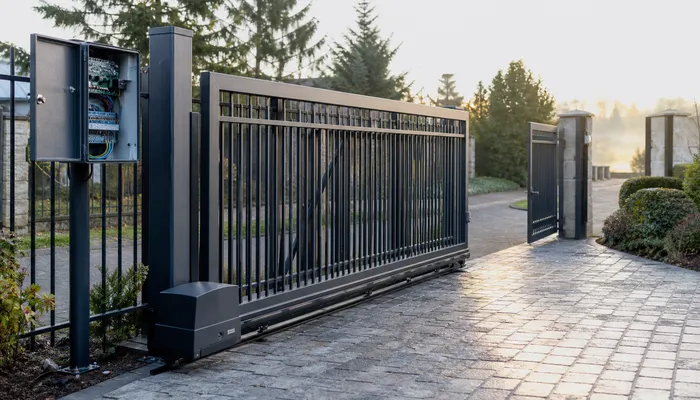

A driveway gate is one of the few exterior upgrades that changes how a property is used every day. It defines the line between the street and the yard, gives the entrance a clear focal point, and cuts down on the number of times a vehicle or a visitor reaches the house unannounced. The hard part is rarely deciding to add a gate — it is figuring out which mechanism will actually work on the driveway you already have.
Choosing an automatic security gate is mostly a question of geometry and daily habit. Swing, sliding and overhead systems all open and close the same driveway, but each one asks for different clearances, different ground conditions and a different level of upkeep. What follows is a practical comparison of the three families, plus the measurements worth taking before anyone puts a number on the project.
Swing Gates: Simple Motion, Specific Space Needs
A swing gate is the closest thing to a front door for a vehicle. It pivots on a hinge post and clears the opening by moving sideways and back, which keeps the hardware simple to service and the motion familiar to most drivers. On a residential driveway, a single leaf typically covers moderate openings; wider entrances often call for a double-leaf design that meets in the middle and splits the moving load across two hinges.
Hinge Side, Grade and Snow Storage
The catch is the arc. A swing leaf needs a clear radius roughly equal to the width it covers, and that arc has to stay free of parked cars, landscaping, downspouts and mailboxes. If the driveway apron is short and the gate would sweep into the sidewalk or the street, the layout needs rethinking before a single post goes in.
Grade matters just as much. A driveway that pitches noticeably from the street toward the garage can leave a swing leaf hanging in the air or dragging on the pavement, depending on where the obstacle sits. In a region with real winters, the area where the gate parks in the open position also has to hold snow, so plow piles and shoveling routes belong in the plan rather than in the post-installation complaints.
Safety hardware deserves the same attention as the mechanism. Reviewing how gate detection sensors affect day-to-day safety before finalizing a design is far easier than retrofitting sensor placement around a finished swing arc later.
Sliding Gates: Straight Lines and Long Frontages
A sliding gate travels parallel to the fence line instead of swinging into the driveway, which makes it the natural choice when the apron is tight or the frontage is long. Instead of a hinge, the leaf rides on a track or a cantilever frame, so the load moves along the ground rather than through a single pivot point.
Ground Track or Cantilever
A ground-track system is the more direct approach: the gate rolls on a rail set into the pavement, with a guide keeping it aligned. It handles heavy leaves well, but the track collects grit, leaves and, in winter, ice, so it needs routine clearing to stay smooth. A cantilever design avoids the ground track entirely by supporting the leaf on rollers and a counterbalanced frame, which keeps the driveway surface clear and reduces the daily maintenance load.
Either way, the ground under the travel path has to be stable. A slab that has settled or a strip of gravel that shifts with the frost will show up as a gate that binds halfway open. When a sliding gate is added to an existing fence line — ornamental iron, vinyl or chain link — the posts that carry the rails and the catch need footings matched to the new load, not just the old fence spacing. Homeowners weighing how a gate fits into a broader security plan can start with these home security considerations with automatic gates.
Overhead and Specialty Options for Tight or Commercial Access
Some driveways simply do not have room to swing or to slide. That is where overhead and vertical-lift systems earn their place: the leaf rises instead of sweeping sideways, which makes them practical on short aprons, narrow side yards, and access points squeezed between a building and a property line.
Where Overhead Systems Fit
Overhead mechanisms are uncommon on single-family driveways and much more common on properties that move a lot of vehicles through a controlled opening: parking lots, service yards, fleet entrances and multifamily buildings. They also pair naturally with access control, because the opening can be triggered and monitored without a driver leaving the vehicle.
Treating the gate as one part of an access-control plan rather than a standalone purchase usually produces a better result. Readers comparing business applications can review the automatic gate advantages for business properties, while residential owners tend to focus on driveway convenience, delivery flow and keeping the opening closed overnight.
What To Measure Before You Ask for a Quote
Gate estimates get more accurate the moment a site is measured, not described. A handful of numbers will tell a contractor which mechanisms are even possible on a given driveway, and they take about twenty minutes to collect with a tape measure and a level.
Measurements To Bring To The Estimate
- Opening width at its widest point, measured between the two points where the gate will land.
- Slope across the opening and along the driveway, with a note on which direction the ground falls.
- Distance from the gate line to the sidewalk, curb and street.
- Side clearance on both sides, including any area where a gate will rest when open.
- Surface material at the gate line — asphalt, concrete, gravel or grass — and whether it is stable.
- Location of downspouts, utility boxes, meters and any visible drainage path, plus whether power already reaches the gate area.
Access Control Options Worth Deciding Early
The mechanism and the entry method should be chosen together, because wiring, posts and housings change when the plan changes. Common options include a remote or key fob for household vehicles, a keypad for regular visitors, an intercom or video entry for guests and deliveries, and sensor-based safety devices that keep the leaf from closing on a person, pet or vehicle. If the property serves multiple tenants or staff, the entry method may also need to record who came in and when.
Next Step: A Site Visit Beats A Guess
Automatic gates are fabricated and fitted around the property, not picked off a shelf. Custom ironwork, matching finishes and a frame built for the actual opening all come out of a shop that makes its own components, which is why a walkthrough matters more than a catalog. Osceola Fence has more than 50 years of experience, an in-house iron fabrication shop, and a team that helps prepare permit paperwork for the work, along with the 1 Year Certified Craftsmanship Guarantee™ on qualifying projects.
For larger gate and access-control installations, qualified customers can apply through the GreenSky® Loan Program; financing is subject to credit approval and applicable GreenSky® terms and conditions. Residential driveways and commercial or industrial entrances are handled on separate lines, so you reach the right team from the first call. Property owners across the Chicago area and surrounding suburbs can also review automatic security gates installed by a local fencing contractor for a project in the service area.
To move forward, request a free estimate or call the line that matches your property: residential projects at 773-278-4762, and commercial or industrial access at 773-417-3107. Have the opening width, approximate slope, property type, access-control needs and target timeline ready — a short site visit will confirm the rest.