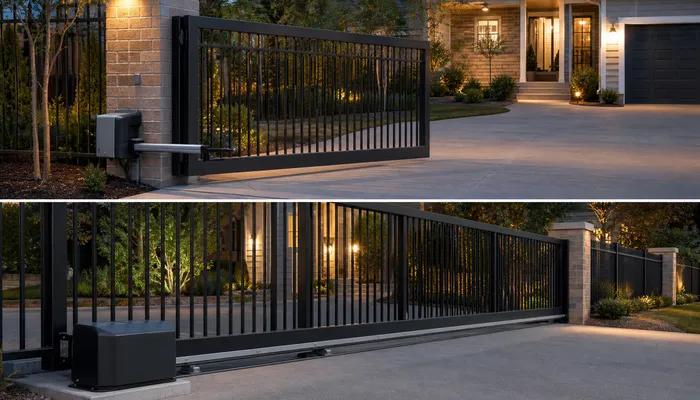

A driveway gate looks simple in a photograph and gets complicated the moment someone walks the property with a tape measure. The gate leaf, the operator, the power run and the entry controls all have to agree with each other, and the first disagreement usually shows up as a leaf that swings into a parked car or a slider with nowhere to travel. Sorting out swing gate vs slide gate geometry before collecting quotes is what keeps a project on budget and out of the revision pile.
The sections below cover the practical side of that choice: how much room each configuration needs, what changes in the operator and power plan, and how entry controls fit into the rest of the perimeter.
What Decides Between A Swing And A Slide Gate
Two measurements settle most of the debate before anyone starts comparing brands or finishes. The first is how much clear space exists beside or behind the opening. The second is how far a gate leaf can travel in a straight line without meeting a fence post, a mature tree, a planter or a neighboring property line.
Driveway width matters, but it is rarely the deciding number on its own. A twelve-foot opening can accept a swing gate comfortably if the apron is deep, and that same twelve feet can rule out a swing gate entirely if the garage wall sits two feet from the edge of the pavement. Slide gates flip the logic: they use very little depth at the opening and need length along the fence line instead.
Swing Gates Need Sweep Room, Not Just Width
A single swing leaf needs an arc roughly the width of the opening, adjusted for the operator’s geometry, in the direction it opens. A double swing splits that arc between two leaves and shortens each sweep, which is one reason double gates stay popular on wider residential drives. Where the driveway slopes toward or away from the street, the hinge point and the operator arm have to be set so the leaf clears the grade through its full travel, not only at rest.
Slide Gates Need A Straight Run Along The Fence Line
A sliding leaf needs clear linear travel at least as long as the opening, plus room to stack when fully open. That travel has to stay straight and consistent, because a run that curves, dips or crosses a drainage swale creates problems that are far easier to catch during a site visit than after installation. Slide gate clearance is the most common reason a driveway that looked ideal for a slider ends up with a swing gate instead.
The question is not which gate type is better. It is which gate type your driveway geometry can actually support.
| What You Are Comparing | Swing Gate | Slide Gate |
|---|---|---|
| Room needed to operate | Sweep area inside or outside the opening | A straight run of fence line for the leaf to travel along |
| Best fit | Wide apron with clear space behind or beside it | Narrow apron with a long, unobstructed fence line |
| Driveway slope | Articulated arms and operators can work with moderate grade changes | Track or cantilever travel is easier to manage on a level run |
| Fence line impact | Posts and hinges on both sides of the opening | Posts plus track or cantilever frame along one side |
| Parking behavior | Vehicles must stay clear of the swing path | Vehicles must stay clear of the travel lane |
Operator, Power And Hardware Choices
Once the configuration is settled, the hardware conversation gets much shorter. The gate type determines where the operator lives, how it is serviced and how the finished entrance looks from the street.
What Changes With The Operator Type
Swing operators typically mount on a post beside the opening and either push the leaf from an arm or sit underground in a housing. Surface-mounted arms are easier to reach for adjustment; underground operators keep the driveway edge visually clean but ask more of the site during installation. Slide operators mount at one end of the travel and drive the leaf along its track or cantilever frame, which changes both where the housing sits relative to the fence line and how the gate reads when it is open.
Comparing gate operator options is really a conversation about service access. Whatever gets installed has to be reachable for adjustment, lubrication and eventual repair, and that requirement can shift a gate a foot or two along the fence line before a single post is set.
Power, Conduit And Weather Exposure
Automatic gates need a power source and a protected path for the wiring to reach the operator. When the driveway is far from the house panel, trenching and conduit become part of the scope, and that work has to be planned before the driveway surface is restored. Freeze-thaw cycles matter here as well: conduit set too shallow can shift over the seasons, and operator housings that collect meltwater will not last as long as housings set with drainage in mind. Solar and battery-backed options exist for openings where trenching is impractical, though they change the maintenance rhythm rather than removing it.
Safety Edges And Sensors Are Part Of The System
A gate that moves on its own needs to detect what is in its path. Safety edges, photo-eye sensors and loop detectors are standard parts of a properly planned system and should be quoted with the gate rather than added later. These devices reduce the chance of a gate closing on a vehicle, a pet or a person; they are safety equipment, not a guarantee, and they only perform when they are installed, aligned and maintained correctly. How those devices behave in real driveways is covered in more detail in our post on gate safety sensors.
Entry Controls: Keypad, Remote, Intercom And Visitor Codes
Residential access control has become flexible enough that control choices can be made after the gate configuration is settled. Remotes and keypads handle daily use, while intercoms and video entry make sense where the gate sits far from the door or where the household prefers to see a visitor before granting access.
Daily Family Use
For most households, a combination of vehicle transmitters and a keypad covers nearly everything. The keypad earns its place the first time someone arrives without a remote. Placement matters more than most people expect: a keypad mounted where a driver can reach it while seated gets used, and one mounted two steps from the car usually gets bypassed.
Visitors, Deliveries And Service Calls
Temporary codes and call-box style entry make it practical to let a delivery driver, a landscaper or a contractor in without handing out a permanent transmitter. If the property sees regular visitors, a video intercom lets someone inside the house confirm who is at the gate before opening it. These are convenience and access-management features, and they should be described honestly: they improve control over who enters the property rather than promising that nothing unwanted will happen.
Matching The Gate To The Pedestrian Door And Fence Line
An automatic driveway gate rarely stands alone. A matching pedestrian gate, a fence line that continues at the same height and finish, and an operator housing that does not read as an afterthought all shape how the finished entrance looks. Homeowners weighing materials and styles alongside the gate hardware can review our automatic gate and access-control work for a clearer picture of how the pieces come together. Properties with a security-focused layout may also want to read home security with automatic gates, and commercial or multifamily owners can see how these systems scale in automatic gates for business properties.
Next Step: Scope The Opening Before You Price The Gate
Gate pricing depends on the opening, the operator, the power path and the controls, so a number given over the phone without a site visit tends to be a placeholder. A few pieces of information make the first conversation far more productive:
- Photos of the driveway from the street and from inside the property
- Approximate width of the opening and length of the driveway
- Whether the driveway slopes, and in which direction
- What sits beside the opening: fence, hedge, retaining wall, garage, parkway
- Distance from the house to the gate line, for the power run
- How many users need access, and whether visitors or deliveries come regularly
With those details in hand, a walkthrough can confirm the configuration, flag anything that affects the power plan or the permit, and put a real number behind the project. Osceola Fence installs and services automatic gates and fencing for residential properties in La Grange and the surrounding suburbs, and qualifying projects are covered by our 1 Year Certified Craftsmanship Guarantee™.
If budget is the sticking point, larger gate and perimeter projects can be financed through the GreenSky® Loan Program for qualified customers, which offers a simple application process, a fast credit decision, multiple financing options and no prepayment penalty. Financing is subject to credit approval and applicable GreenSky® terms and conditions.
Send your photos and measurements through our contact page, or call the residential line at 773-278-4762 to schedule a walkthrough of the opening.