Skip to content


Fence work rarely starts with a material decision. It starts with a property line, a plat of survey, a neighbor’s garage, a driveway that holds water every March, and a budget that has to cover all of it. That is the practical frame for South Suburbs Chicago fence planning: one region, five distinct coverage areas — Broadview, Harvey, Joliet, Markham and Westchester — and a set of decisions that repeats from block to block even when lot sizes do not. Osceola Fence is a Chicago-based fence contractor working across Cook County and into Will County, so this guide follows the way a site walk actually unfolds.
Illinois Sets the Tone, but the Municipality Sets the Fence Rules
Illinois is a Midwestern state with an estimated population of about 12.7 million, based on the Census Reporter profile for Illinois and U.S. Census ACS 5-year estimates. Chicago is the state’s largest city and Springfield is the capital, and the fencing market follows that shape: dense residential blocks, suburban lots with rear alleys, small commercial corridors and heavier industrial parcels all sit within a short drive of one another.
What does not travel is the paperwork. Permit forms, height limits, visibility triangles and setback language are written municipality by municipality, so an approved fence line in one coverage area says very little about the next. Read the state’s geographic context for orientation; read your own building department for the rules.
South Suburbs Chicago Fence Planning Starts With Two Questions
Before anyone prices a panel, two questions decide most of the outcome: who uses the property, and what the fence has to accomplish.
- Residential: privacy from a neighboring second story, a contained perimeter for a dog, a pool enclosure, curb appeal from the street.
- Commercial or industrial: defined customer parking, controlled vehicle access at a dock, a fenced storage yard, screening for equipment.
A backyard privacy run and a commercial perimeter can share a property line and almost nothing else. Post spacing, gauge, gate hardware and finish expectations all move once the audience changes.
Materials That Hold Up Through Freeze-Thaw and Road Salt
Northern Illinois works on a fence from three directions at once: frost lifting soil around footings, snow load pressing on panels, and salt thrown up from alleys and plowed streets. The material choice should answer that reality rather than a catalog photo.
Chain Link Fences
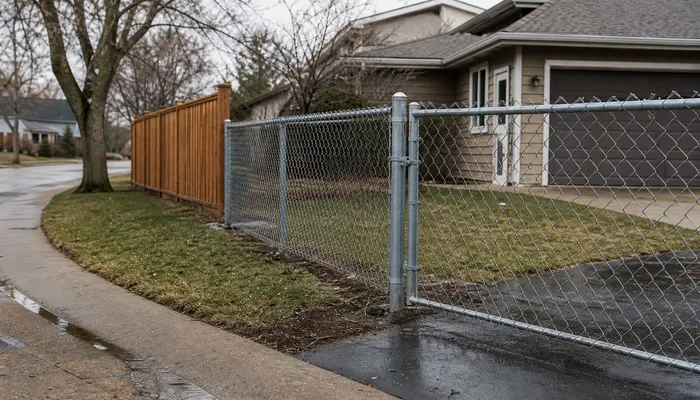
Chain link stays the workhorse for side yards, dog runs, storage yards and commercial boundaries. Galvanized and vinyl-coated systems both perform; the difference usually shows up in coating and post gauge rather than in the mesh itself. For how the material is actually built, the versatility of wire fencing is a fair primer.
Wood and Vinyl Privacy Lines
Wood offers the warmest look and the most design flexibility at the lowest material cost, but it asks for sealing and periodic inspection of posts and rails. Vinyl removes the finishing work and holds color where a fence is visible from the street. Composite sits between the two on price and handles wet cycles well. Homeowners weighing privacy options can start with sturdy lumber fences for security for the realistic limits of a wood run.
Iron, Steel and Commercial Aluminum
Ornamental iron and steel get specified where appearance and longevity both count: front yards, parkway strips, courtyard entries, and commercial frontage that has to look maintained. Commercial aluminum delivers a similar read with less weight and no rust concern. Domestic aluminum barrier options are worth reviewing before a multifamily or retail perimeter is priced.
Automatic Security Gates
Gates are usually the last item added and the first one to cause trouble, because leaf, operator, power run and entry controls all have to agree. On a residential driveway the question is swing versus slide. On a commercial site it becomes traffic volume, fail-safe behavior and how visitors announce themselves.
Five Coverage Areas, Five Different Site Conditions
The group name points south, but the coverage map is wider. Four of the five communities sit in Cook County; one sits in Will County. Planning assumptions should follow the map, not the label.
Broadview
Broadview is a village of roughly 7,900 residents in Proviso Township, about 12 miles west of downtown Chicago. Lots are compact and side yards are narrow, so gate placement and post spacing do most of the work in keeping a run usable. Chain link fence installation in Broadview, IL is a frequent starting point for side-yard and dog-run projects.
Harvey
Harvey, in Thornton Township, is one of the larger communities in the group at roughly 19,800 residents. The mix runs from older residential blocks to small commercial frontage, which means two different briefs can arrive in the same week: a backyard privacy line and a fenced lot with vehicle access. Commercial fencing in Harvey, IL usually turns on gates and clear sight lines at the entry.
Joliet
Joliet is the outlier in both size and geography. With an estimated population near 149,800 and a seat as Will County’s county seat, it supports longer runs, larger commercial perimeters and more industrial-adjacent work than the Cook County communities. Fence installation planning in Joliet, IL should start earlier, because the permit packet asks for more before a crew is scheduled.
Markham
Markham, in Bremen Township, is a city of roughly 11,400 residents with housing stock that rewards privacy fencing: fairly standard lot widths and rear yards that back onto other yards. Privacy fence installation in Markham, IL is usually a wood, vinyl or composite conversation rather than a metal one.
Westchester
Westchester is a village of roughly 16,500 in Proviso Township, west of Chicago, where a good share of the work is replacement rather than new construction. When a fence has already survived two decades, the question shifts from what to build to what can be reused. Vinyl fence installation in Westchester, IL and gate replacement are both common asks.
Permits: Where South Suburbs Chicago Fence Planning Meets the City
Joliet publishes a fence permit packet through its Building & Inspectional Services Division, and it is specific. An application needs a completed form, a plat of survey with the proposed placement marked, the proposed height and material, and a cost estimate. Where a contractor performs the work, the contractor applies for the building permit. Height is capped at 4 feet in a front yard and 6 feet in a side or rear yard depending on visibility, anything above 6 feet requires Zoning Board of Appeals approval, and posts may not sit directly on a property line. Solid privacy fencing inside a visibility triangle is limited to 2.5 feet, and corner lots carry a 20-foot corner side yard setback with neighbor sign-off required above 4 feet in that area.
That is useful guidance for a Joliet project and only a Joliet project; the city’s fence permit packet is the current source. Broadview, Harvey, Markham and Westchester write their own forms and limits, and a rule carried from one municipality into another is how a fence gets built twice. Treat any summary as planning guidance, not legal advice, and confirm requirements with the city before material is ordered.
What to Have Ready Before the Walk-Through
An estimate gets faster and more accurate when the visit starts with information instead of guesses.
- A plat of survey or other property line documentation, if it exists.
- Approximate linear footage, or rough yard and lot dimensions.
- Photos of the existing fence, the shared lines and any gates.
- The intended use: pets, children, pool, privacy, parking control, storage yard.
- Gate and access-control needs, including how vehicles and visitors should announce themselves.
- Any known easement, drainage swale, transformer or pedestal on the line.
- A target timeline and a working budget range.
Utility locating belongs at the front of the schedule as well. In Illinois, JULIE (811) notification is the standard step before excavation, and it is not something to skip on a fence with deep footings.
Why Owners Compare More Than Price
Osceola Fence has worked the Chicago area for more than 50 years, fabricates custom ironwork in-house, and helps owners prepare permit paperwork instead of handing over a folder and a phone number. Qualifying projects are backed by the 1 Year Certified Craftsmanship Guarantee™. For larger gate and perimeter work, the GreenSky® Loan Program is available to qualified customers with a simple application, a fast credit decision, multiple financing options and no prepayment penalty; financing is subject to credit approval and applicable GreenSky® terms and conditions.
Frequently Asked Questions
Do fence projects in these communities need a permit?
Most do. Joliet lists a fence permit among the residential construction types that require Building Department review and Zoning Department approval, and the contractor is typically the applicant when hired for the work. Broadview, Harvey, Markham and Westchester each run their own process, so confirm with the local building department before work begins.
How tall can a fence be?
In Joliet, the packet caps fences at 4 feet in the front yard and 6 feet in a side or rear yard depending on visibility, with anything taller routed to the Zoning Board of Appeals. That is a Joliet figure; other municipalities set their own limits, and none of them should be assumed.
Is chain link the right choice if privacy matters?
Chain link is efficient at defining a boundary and keeping sight lines open, which is exactly what some commercial and side-yard projects need. Where privacy is the priority, wood, vinyl or composite panels usually fit the goal better, and the cost difference is often narrower than expected once finishing is factored in.
How long does installation take?
It depends on linear footage, material lead times, gate and operator work, and whether a permit is required. A walk-through produces a realistic schedule; a phone estimate does not.
Do you work across all five communities?
Yes. Coverage runs through Broadview, Harvey, Joliet, Markham and Westchester and the surrounding Cook County and Will County areas. Residential questions go to (773) 278-4762 and commercial or industrial questions to (773) 417-3107.
What should I do about easements and utility equipment?
Flag anything that looks like a drainage swale, an easement, a transformer or a pedestal before the layout is final. Joliet’s packet, for example, restricts fences in landscape easements and requires clearance around ComEd equipment, and utilities can require removal of a fence placed in an access easement. Ask the city and the utility before the line is painted.
Start With the Property, Then the Panel
Good South Suburbs Chicago fence planning is unglamorous: a survey, a measurement, a call to the building department, and a material that suits the weather. Get those in order and the project rarely surprises anyone. If your property sits in Broadview, Harvey, Markham or Westchester, or on a larger lot in Joliet, the next step is a short conversation about the site rather than a price per foot — reach the team through the contact page and a walk-through can be scheduled.