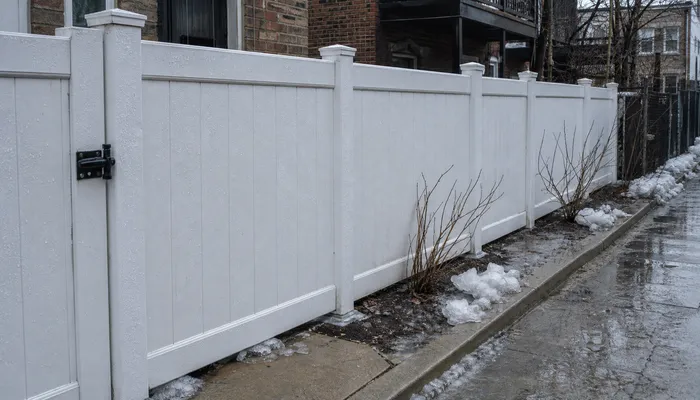

Every spring, fence lines across Chicago tell the story of the winter they just survived. Some panels lean a few degrees out of line, some post bases sit in a ring of wet gravel, and a gate that used to swing freely now drags against its latch. Fence durability in freeze-thaw climates is decided mostly underground, in the soil that surrounds each post, long before any of it becomes visible in a panel.
That matters because winter here is not a single event. It is a long sequence of melting and refreezing, of slush pushed against fence bases, of meltwater that has nowhere to go because the ground beneath it is still frozen. Chicago sits on the western shore of Lake Michigan, and that position shapes the season in ways inland cities do not experience. If your fence looks tired every March, the reason is usually in the ground and along the base of the fence, not in the color of the material.
Why Chicago Ground Moves Every Winter
A freeze-thaw cycle is simple physics with expensive consequences. Water sitting in the soil around a post expands as it freezes, then releases as it melts, and every cycle leaves the ground slightly rearranged. Over one Chicago winter that repetition can lift a shallow footing, widen the gap between a post and the rails it carries, or push a gate frame far enough out of square that the latch no longer lines up. None of it looks dramatic in any single week. It accumulates.
The most exposed fence lines are the ones where meltwater collects and lingers: the low side of a sloped yard, the strip of lawn that never quite dries, the area where a downspout releases onto the same ground every storm. Saturated soil freezes harder and moves more than dry soil, which is why a fence on flat, well-drained ground often outlasts an identical fence a few doors away on a lot that holds water.
Wind load matters alongside ground movement. A solid fence panel acts like a sail in a winter storm, and every gust puts lateral force on the posts. When footings are undersized or set too shallow for local frost depth, the post has nothing holding it against that pressure. The panel stays intact while the line slowly tilts.
Signs That Point to Soil Movement, Not Ordinary Wear
- Posts that are visibly out of plumb when you sight down the fence line
- Gaps opening between the top rail and the panel, or between panels themselves
- A gate that drops, sticks or drags after a hard freeze
- Post bases surrounded by cracked, heaved or unusually soft ground
- Fasteners pulling proud of the surface on one section but not another
If those signs appear along a whole run rather than in one spot, the issue is usually the original installation detail rather than a defective panel.
What Road Salt and Meltwater Do Near Sidewalks and Alleys
Chicago winters are managed with salt, and salt does not stay where it is spread. Plows push treated snow into the edges of parkways, driveways and alley aprons, where it melts slowly against whatever fence line runs alongside. The result is a splash zone: the bottom foot or two of a fence, plus the hardware near it, sitting in chloride-laden meltwater for weeks at a time.
For most fences, the visible surface is not where the trouble starts. It starts with the parts that cannot dry out: the base of a post, the brackets holding a gate, the fasteners that connect rails to posts. Standing moisture plus salt residue accelerates corrosion on anything metal, including hinges, latches and screws, even when the panel itself is unaffected.
It also helps to separate surface residue from real damage. A white chalky film, dried salt lines or grit caught in panel channels usually rinse away with a garden hose and a soft brush once the season turns. What does not rinse away is a coating that has flaked, a wood post that has gone soft at grade, or rust bleeding out of fasteners and staining the material around them. That is a repair question, not a cleaning question.
Snow storage is part of the same conversation. If the plow always leaves a pile against the same section of fence, that section is getting pressure from the snowbank and prolonged contact with meltwater at the same time. Adjusting where snow gets piled, or reinforcing that stretch during installation, solves a problem that reappears every year otherwise.
Which Fence Materials Handle It Best
Materials respond differently to the same winter, and the differences show up in maintenance, not just in appearance.
Wood is the most moisture-reactive option. Boards absorb water, dry, shrink and swell, and any protective stain or paint film breaks down over repeated cycles. The failure point is almost always at grade, where a post stays wet the longest. Wood fences can perform well in Chicago, but they ask for recoating and periodic inspection of the post bases to stay ahead of rot.
Painted metal fencing depends on its coating. The steel underneath is strong and the profile is thin, so it sheds snow well, but every scratch, chip or fastener penetration is a place where moisture and road salt can begin working on bare metal. Touch-up maintenance after winter is what keeps that coating doing its job.
Vinyl panels behave differently because the surface is non-porous and the color runs through the material rather than sitting on top of it. Meltwater and salt splash do not soak in, and the panel does not need repainting or resealing after a hard season. Where vinyl still needs attention is at the connection points, which is why the hardware and the footing matter as much as the panel. You can see examples of vinyl fencing built for Chicago weather on the main service page.
One honest caveat applies to every rigid material: in sustained deep cold, panels are less forgiving of impact than they are in July. A snowblower thrown against a fence at zero degrees is a different event than the same bump in summer.
Why Installation Detail Beats the Spec Sheet
Two fences made from identical panels can age very differently on the same block. The variables that decide it are practical: how deep the posts are set, how wide the footings are, whether the concrete or gravel at the base drains, whether fasteners are corrosion-resistant, and whether the panels were installed with room for minor seasonal movement instead of being locked tight against it. Material selection sets the ceiling on performance. Installation quality decides whether you get close to that ceiling.
Planning a Fence Line That Survives the Season
If you are replacing a fence or starting from an empty property line, the decisions that protect you from freeze-thaw damage happen before anything is ordered.
Start with drainage and slope. Walk the line in wet weather and note where water stands. A layout that keeps post bases out of the lowest spots, or that adds a small drainage path, is worth more than an upgraded panel. Grade changes also matter for height and gate clearance, especially on properties where the yard falls away from the house.
Next, locate what is under the ground. Any digging inside the City of Chicago limits should go through 811 Chicago, either online or by calling 312-744-7000, because JULIE handles Illinois outside the city rather than Chicago addresses. Knowing where gas, water, electrical and sewer lines run determines where posts can actually go. You can review the city’s overall geography and boundary context through OpenStreetMap, and general background on the city and its lakefront climate is available on Wikipedia.
Permits come next, and they depend on what you are building. In Chicago, a fence more than 5 feet high requires a permit, while a fence at or below 5 feet that complies with the zoning code may be exempt from a building permit. Landmark districts, corner lots, masonry work and other conditions can change that picture, so the safe approach is to confirm the specifics with the City of Chicago Department of Buildings before installation rather than after. A contractor who is used to city work will know which questions to ask and what documentation to prepare.
The final walkthrough is where you catch the small things that become large ones. Check that posts are plumb and gates swing cleanly, that fasteners are set correctly and corrosion-resistant, that water drains away from post bases instead of toward them, and that any snow storage area is not landing on a single vulnerable section. If the fence line runs along a narrow lot, gangway or tight property line, the layout questions get more specific, and we cover those in our guide to how narrow city lots and gangways affect fence lines.
Once a fence is up, the seasonal routine is short. Rinse salt residue and grit off the lower panels in spring, keep an eye on gate hardware, and check post bases after the thaw. The rest of the year, most fences need very little, which is the point of our routine vinyl fence maintenance walkthrough. If you are comparing materials and want to see how they hold up specifically through a Chicago winter, our material comparison covers material behavior through a Chicago winter in more detail.
Request an On-Site Assessment
A fence that leans every March is usually fixable, and sometimes it does not need to be replaced at all. The useful first step is an assessment of the actual line: how the soil drains, how the posts were set, where the movement is coming from, and whether the current configuration is worth repairing or rebuilding.
We evaluate existing fence lines and proposed layouts on site, and we can walk through post depth, footing, drainage and hardware choices before you commit to anything. For homeowners, call the residential line at (773) 278-4762. For commercial, industrial and multi-property work, call (773) 417-3107. You can also request an appointment through our contact form, and we serve Chicago and the surrounding communities.
Winter will do what winter does. The goal is a fence line that goes into it set deep enough, drained well enough and detailed correctly enough that spring arrives without a repair list.