

Industrial Fencing Trends & Innovations (2025)
Industrial perimeters are evolving fast. From anti-ram systems to AI-enabled monitoring, today’s fences are engineered to reduce risk, improve uptime, and simplify maintenance—without slowing down operations. Read along to see the new Industrial fencing trends & innovations.
For local specs and planning, see our Chicago industrial fencing page.
Snapshot of What’s New & Why It Matters
| Trend | What it is | Why ops teams care |
|---|---|---|
| Welded wire goes mainstream | Rigid panels with tighter apertures & tamper-resistant hardware | Higher climb/cut resistance than standard chain link; clean look |
| Integrated gate safety | UL 325/ASTM F2200-compliant operators, edges, photo-eyes, loop logic | Fewer incidents, better throughput, easier audits |
| Anti-ram solutions | Crash-rated beams/bollards per ASTM F2656 | Protects against vehicle threats; often paired with fence infill |
| Perimeter intrusion detection (PIDS) | Fiber optic microphonic cable, accelerometers, or radar/IR lines | Detects cutting/climbing with zone-level alerts |
| AI video & LPR | Analytics detect people/vehicles; license plate recognition | Fewer false alarms; better incident triage |
| Corrosion “duplex” systems | Hot-dip galvanizing + powder coat | Longer life cycles; lower total cost of ownership |
| Modular & prefab kits | Pre-engineered posts/panels/gate frames | Faster installs; predictable quality on tight timelines |
| Sustainability focus | Recycled steel, low-VOC coatings, durable designs | Meets ESG goals; reduces repainting/replace cycles |
| Privacy + wind engineering | Screens/perforated panels with wind-load calcs | Visual control without overstressing posts/footings |
| Spec transparency | ASTM F1043/F567 framework, documented gauge/mesh | Easier bids, fewer surprises, smoother inspections |
This is strictly what’s changing and why it matters operationally.
1) Adoption shift: welded-wire panels over generic fabric
Not a “what is it” primer—procurement behavior is changing. RFPs increasingly call for rigid panel systems with tamper-resistant fasteners and defined aperture sizes. Outcome: clean camera sightlines and fewer climb attempts. Tip: specify acceptable panel families and hardware, not brand names.
2) Gate intelligence as an operations tool
Gate operators now report cycle counts, obstruction events, and safety faults to facility teams. This turns gates into preventive-maintenance assets. Write into specs: monitored safety devices, event logging, and remote notification hooks—so failures are predicted, not discovered at shift change.
3) Vehicle-threat posture without fortress optics
Crash mitigation is moving below the sightline. Facilities pair rated beams/bollards with architecture.
4) PIDS that your team actually trusts
Next-gen fence-mounted analytics label events (cut, climb, rattle) and suppress wind/animal noise. The win isn’t hardware; it’s fewer false dispatches. Contract for a tuning session after install and require a max false-alarm rate in the acceptance criteria.
5) Coatings & corrosion: lifecycle math in the bid room
Duplex systems (HDG + powder) keep winning because owners now compare repaint cycles and touch-up cost over 10–15 years. Put a maintenance schedule and touch-up spec in the SOW; make warranty conditional on documented inspections.
6) Privacy with wind responsibility
Where screening is required, engineers are sizing posts/footings to site wind exposure instead of “standard line posts.” Your spec should tie screens to a wind model (exposure category, height, terrain). That eliminates mid-project adders and keeps panels on the rails when storms hit.
7) Modularization for multi-site rollouts
Pre-engineered posts, repeatable gate frames, and SKU-stable hardware let national portfolios install faster and stock fewer spares. Ask vendors to show part commonality across heights and sites; it reduces downtime when a forklift kisses a panel.
8) ESG that’s not greenwash
Owners are counting repaints avoided, recycled content, and service miles saved via fewer callouts. If your project reports ESG, require materials declarations and a service plan that quantifies avoided trips.
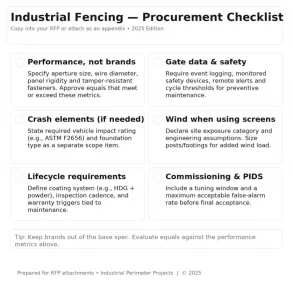
Procurement checklist (copy into your RFP)
- Performance not brands: aperture size, wire diameter, fastener tamper class, panel rigidity.
- Gate data: event logging, monitored safety, remote alerts, cycle thresholds.
- Crash elements (if needed): required rating and foundation type as a separate scope.
- Wind with screens: state exposure category + design assumptions.
- Lifecycle: coating system, inspection cadence, warranty triggers.
- Commissioning: PIDS tuning window and max false-alarm rate.
Explore project options on our industrial fence in Chicago page.
KPIs facilities are tracking in 2025
- False-alarm rate (PIDS/cameras)
- Mean time to repair (gate faults)
- Unplanned perimeter outages per quarter
- Lifecycle cost vs. baseline spec over 10 years
As an industrial fencing company, we continue to evolve with these trends and innovations that continue shaping the future of security and design for industrial properties. From technological advancements to sustainable materials and customizable designs, industrial fencing is becoming more than just a security measure – it’s a reflection of our company’s commitment to both security and aesthetics.
For high-quality Chicago fence installation solutions , look no further than Osceola Fence & Security Corp. We specialize in innovative security and design options, providing customized solutions to meet the unique needs of industrial properties.