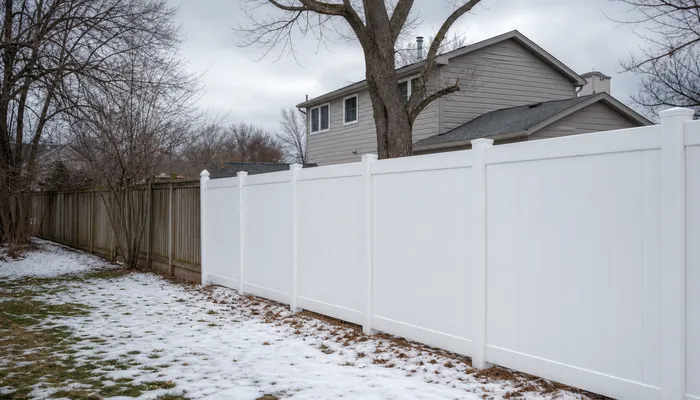

Vinyl fence installation DuPage County homeowners are quoted for in spring has to survive the following February. That single fact shapes the whole material decision across the western suburbs of Chicago, whether the property sits in Bensenville, Wood Dale, Lombard, Hillside, or Northlake. The corridor shares one pattern: wet snow, hard freezes, repeated thawing, and a spring melt that leaves the ground saturated for weeks.
This guide compares vinyl and wood on the terms that matter in northern Illinois — how each material handles moisture and frost, what maintenance each one demands, and where local permit rules differ from one municipality to the next.
How Illinois Winters Test Every Fence Line
A fence rarely fails all at once. Posts move first. Water collects around a footing, freezes, expands, and nudges it slightly out of plumb. Repeat that across a few winters and a gate that closed cleanly in October starts dragging by March. Wind adds a second load, especially on open lots and long driveway runs where gusts have a clear path to the panels. Road salt adds a third stress on anything metal, and heavy snow tests the top rail and the fasteners holding it.
None of that is a reason to skip a fence. It is a reason to choose the material, the footing depth, and the gate hardware with winter in mind rather than spring.
Vinyl Fence Installation DuPage County: How It Compares To Wood
Vinyl and wood are both common across this corridor, and both perform well when the installation is done correctly. The difference shows up in what the fence asks of you after it is standing.
Where Vinyl Holds Up Better
Vinyl is a manufactured material, so it does not absorb water, rot, or feed insects — a genuine advantage in a region where the ground stays wet into April. Most residential grades are color-through, which means a scratch does not expose bare wood the way a gouge in a stained board does. Washing it down is essentially the entire maintenance list, and that routine is spelled out in our guide to seasonal care for vinyl fences.
For a homeowner who wants privacy without an annual staining project, vinyl is usually the simpler answer. That is especially true on long fence runs, where upkeep is measured in weekends. Properties that move through vinyl fencing in Bensenville, IL tend to fit this pattern closely: modest yards, shared property lines, and a preference for a fence that looks the same in year eight as it did in year one.
Where Wood Still Makes Sense
Wood remains the warmer material visually, and it can be repaired board by board. If a section gets damaged, a carpenter can replace pickets instead of the entire run. Cedar and pressure-treated pine also take stain and paint well, which gives a homeowner control over color and finish.
The trade-off is upkeep. In this climate, wood generally wants cleaning and sealing every couple of years, plus a close look at the posts after every hard winter. Homeowners who enjoy that kind of project, or who want a look vinyl cannot replicate convincingly, still choose wood — wood fence installation in Hillside, IL often complements established landscaping on older residential blocks.
What Both Materials Need From The Ground
Material choice matters less than the footing. A vinyl fence installation DuPage County homeowners will live with for twenty years is only as straight as the posts underneath it. Vinyl and wood fail the same way when posts are set too shallow or in soil that does not drain. The standard worth expecting is described in our guide to what a proper vinyl fence installation should include: posts below the frost line, concrete shaped so water runs away from the post rather than into it, and gate posts heavier than the fence posts around them.
Residential, Commercial, And Industrial Properties Need Different Answers
The same material comparison lands differently depending on who is on the other side of the fence.
Backyards, Side Yards, And Privacy
For a single-family home, the priorities are usually privacy, pet containment, and how the fence looks from the kitchen window. Vinyl privacy panels handle all three and hold their color without annual work. Wood stays the pick for homeowners who want a specific stained look or who plan to modify the fence later, whether that means adding a gate, a trellis, or a section of lattice.
Business And Multi-Property Perimeters
Retail parking lots, multifamily buildings, and mixed-use properties care about sightlines and access. Chain link and ornamental metal are common because they define a boundary without blocking visibility, and they pair well with automatic gates and controlled entry points. Height, gate placement, and vehicle turning radius usually drive the design more than the panel material does.
Warehouses, Yards, And Loading Areas
Industrial sites across the corridor — including the warehouse and distribution blocks along the I-294 and Mannheim Road edges — need perimeter fencing that separates truck traffic from pedestrians, screens stored material, and tolerates impact. Heavier-gauge chain link, ornamental steel, and sliding or cantilever gates are the usual starting points. For those projects, the commercial line is (773) 417-3107.
Fence Rules Change From One Municipality To The Next
Illinois does not publish one fence code that applies statewide. Each village and city writes its own ordinance, and the differences are practical: permitted heights, setback distances from the property line, whether a front-yard fence is allowed at all, and which side of the fence must face the neighbor.
Northlake is a clear, verifiable example. The city requires a permit before a fence, barrier, or similar structure is built, and applications are filed with the Building Department. Under Northlake’s fence chapter, rear-yard fences are limited to six feet in height, every portion of a fence must sit within the owner’s property and at least three inches off the property line, and a fence is not permitted in the area between the front of a house and the street. Where a fence has two different sides, the finished side faces away from the property it was built on.
None of those Northlake figures should be assumed to apply in Bensenville, Wood Dale, Lombard, or Hillside, since each of those communities follows its own ordinance. The practical takeaway is to confirm the rules that govern your address before a design is finalized — not after a crew is scheduled. A chain link fence installation in Northlake, IL, for instance, has to clear the same front-yard restrictions that apply to any other barrier type in that city.
One step applies everywhere in Illinois: before any digging for posts, request a utility locate through JULIE by calling 811. It is free, and it keeps a post hole from turning into an expensive repair.
Choosing A Vinyl Fence Installation DuPage County Homeowners Can Trust
This group of suburbs spans two counties — DuPage and Cook — and several permitting jurisdictions, so a contractor working across the corridor already knows that the paperwork changes from town to town. Osceola Fence & Security has served Chicago and the surrounding suburbs for more than 50 years, and the team handles permit preparation and inspection scheduling as part of the project instead of leaving it with the homeowner.
Two things are worth checking when comparing bids. First, whether the company fabricates its own ornamental iron and gate components in house, which matters when a gate has to match a fence line and a motor has to be sized to it. Second, whether the work is backed in writing — qualifying projects carry the 1 Year Certified Craftsmanship Guarantee™. The company is licensed and insured, and financing through the GreenSky® Loan Program is available to qualified customers; financing is subject to credit approval and applicable GreenSky® terms and conditions.
The same estimating sequence applies in every community. Fence contractors serving Lombard, IL, for example, start with the actual property line, then confirm the height and setback rules for that address, then match the material to the yard and the budget, and finally settle gate and access details. Getting those four items resolved before a crew is scheduled is what keeps a project moving.
Maintenance calls follow a similar path, and they usually start at the posts rather than the panels. A fence repair in Wood Dale, IL often comes down to whether the footings have shifted — if they have, replacing pickets will not fix a leaning line, and a good estimate says so plainly.
Frequently Asked Questions
Is Vinyl Or Wood Better For A Fence In The Chicago Suburbs?
Both work, but they ask for different things. Vinyl needs very little routine upkeep and does not absorb moisture or rot, which suits wet springs and repeated freeze-thaw. Wood needs periodic cleaning and sealing and a closer look at the posts after hard winters, but it can be repaired piece by piece and accepts stain or paint in almost any color.
Do I Need A Permit To Install A Fence In This Area?
In most of these communities, yes. Permit requirements, allowed heights, and setbacks are set at the municipal level rather than the state level, so a fence that is fine in one village may exceed the limit in the next. Confirm with the local building department before ordering materials.
Can A Fence Be Installed During Winter?
It can, though ground conditions matter. Frozen or saturated soil affects how footings are dug and how concrete cures, so scheduling usually depends on the specific week and site rather than the season as a whole. Spring and fall stay the busiest windows for that reason.
How Is Pricing Determined For A Fence Project?
Linear footage, material, height, gate count, terrain, existing fence removal, and access for equipment all move the number. Those details are why estimates are based on a site visit rather than a per-foot rate over the phone — our vinyl fence cost guide breaks down how the main cost factors stack up.
Does The Material Change How Long A Fence Lasts?
Less than the installation does. A properly footed wood fence can outlast a poorly installed vinyl one, and the reverse is just as true. Climate exposure is unavoidable here; what separates a fence that holds its line for decades from one that does not is how the posts were set and how water moves around them.
Which Communities Does Osceola Fence Serve In This Corridor?
The team works throughout the western suburbs, including Bensenville, Wood Dale, Lombard, Hillside, and Northlake, along with Chicago and the surrounding area. Residential projects can be discussed at (773) 278-4762, and commercial or industrial perimeter work at (773) 417-3107.
Material comparisons are useful, but they are still general. What settles the question is the property itself: where the line falls, how the yard drains, what the local ordinance allows, and how the gate will be used every day. A free estimate pulls those details together and turns the comparison above into a real scope and a real number — reach the team through the contact page to schedule one.