Skip to content

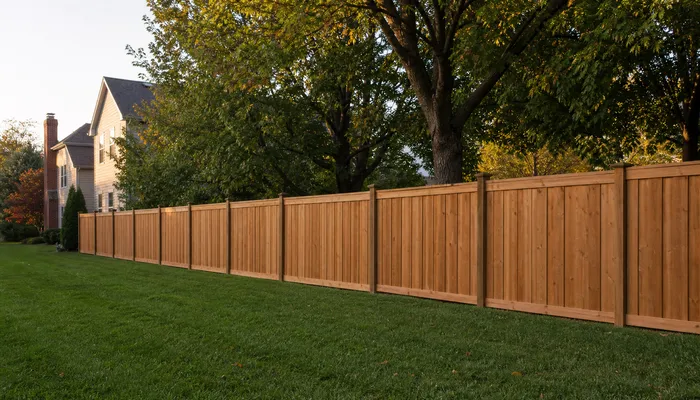
Privacy fence installation North Shore Illinois is a village-by-village matter: each community sets its own height limits, setbacks, and permit steps, so two properties a few miles apart can follow different rules. This guide explains how local fence codes generally work in Illinois, walks through one verified example with real figures, and shows how the five communities in this group compare.
Illinois Handles Fence Rules at the Local Level
Illinois is a Midwestern state with roughly 12.69 million residents, according to U.S. Census Bureau estimates collected by Census Reporter, and its northeastern corner along Lake Michigan is where most of the region’s residential and commercial fencing work takes place. Wikipedia’s overview of Illinois describes a state that borders Lake Michigan to the northeast, the Mississippi River to the west, and the Wabash and Ohio rivers to the south, with Chicago as its largest city and Springfield as its capital.
What Illinois does not publish is one statewide fence height limit. Height, placement, and permit requirements belong to incorporated villages and cities, which adopt their own fence chapters or fold fence rules into zoning and building codes. A village can cap solid fences at one height and open fences at another, require a specific distance between the fence and the street pavement, and ask for a permit before any post is set.
What Northern Illinois Fence Codes Typically Address
The exact wording changes from one municipality to the next, but the same categories appear repeatedly:
- Height by fence type. Many villages define open fences (pickets, iron, chain link, spaced boards) separately from solid fences (privacy panels in wood, vinyl, or composite) and give each its own maximum.
- Setbacks. Front-yard fences are often measured from the street pavement, while side and rear fences are measured from the property line.
- Easements and utility corridors. Fence posts are generally kept out of public easements, and buried utilities must be located before digging.
- Sight lines. Fences near intersections are commonly limited so drivers retain visibility.
- Permits and inspections. Many villages list fences on their building permit applications, request an up-to-date plat of survey, and require an inspection once the installation is finished.
A Verified Example: Riverwoods Fence Height Limits and Setbacks
Riverwoods publishes its fence rules in the Riverwoods Village Code, Title 8, Chapter 9, through American Legal Publishing. Based on the code as reviewed as of 2026:
- Open fences are limited to 8 feet in height and, when located in a front yard or adjacent to a street, must be set back at least 20 feet from the street pavement.
- Solid fences are limited to 6 feet, with the same general 20-foot street-pavement setback. Solid fences that do not exceed 4 feet have a reduced 15-foot setback.
- No fence may be installed within 2 feet of a public sidewalk, bicycle path, or multi-use path.
- Fencing used to screen recreational vehicle storage may not exceed 10 feet and may not extend farther at that height than screening requires.
- Driveway gates must be placed beyond the right-of-way or street-easement line and far enough from the pavement for a vehicle to pull off the road safely.
- The village fee schedule lists a fence permit fee of $150 plus $0.20 per lineal foot, and permits expire one year after issuance. Permitted work hours are Monday through Friday, 7:00 AM to 7:00 PM, and Saturday, 8:30 AM to 5:00 PM. Fence violations can carry fines of up to $750, with each day of a continuing violation treated as a separate offense.
Those figures apply to Riverwoods only. Every village in this group maintains its own chapter, so the same fence design has to be checked against the municipality where it will actually be built.
Privacy Fence Installation North Shore Illinois: How the Communities Compare
The five communities in this group sit in two counties, and each runs its own review process. Population figures come from 2023 American Community Survey five-year estimates and are included mainly for scale:
- Homeowners planning privacy fencing for Arlington Heights, IL are working inside Cook County’s Wheeling Township, in the largest community of this group at roughly 76,220 residents.
- Anyone arranging wood fence installation in Northfield, IL is dealing with a much smaller village of about 5,683 residents in Northfield Township, where yard-by-yard planning matters more than volume.
- Projects that call for vinyl fence installation for Prospect Heights, IL also fall inside Wheeling Township; the city counts roughly 15,681 residents.
- Property owners considering custom iron fencing in Riverwoods, IL are in Lake County, where the population is about 3,988 and the fence chapter summarized above applies.
- For chain link fencing and gate work in Zion, IL, also in Lake County, the population is roughly 24,466, with residential streets and light commercial corridors to plan around.
Two villages inside the same county can still differ on height limits, setback distances, and permit paperwork, so it is worth confirming the local chapter before ordering materials.
Materials for a Privacy Fence Installation in North Shore Illinois
Material choice usually comes down to how much privacy, maintenance, and lifespan a property owner wants. Wood remains the most common screening option, and a properly built cedar or pressure-treated fence can be sealed or stained to handle freeze-thaw cycles, road salt, and wind. Our Wood Fences: A Comprehensive Guide walks through board styles, post depth, and finishing choices in more detail.
Vinyl and composite panels deliver privacy with less upkeep and are often chosen where a consistent look matters across a long run. Cost depends heavily on height, panel style, gate count, and site access, and our Vinyl Fence Cost Guide explains what drives those numbers. Iron, aluminum, and chain link serve a different purpose: boundary definition and visibility rather than screening, which is why they pair well with automatic security gates on driveways and commercial entrances.
Permits, Surveys, and Utility Locates Before Digging
Permit steps vary by village, but the general sequence is consistent: confirm the local fence chapter, prepare a current plat of survey, submit the application with proof of contractor liability insurance, and schedule the inspection once the fence is standing. Our overview of Navigating Fence Installation Codes And Permits covers how those requirements fit together.
One step applies everywhere in Illinois outside Chicago: contact JULIE, the state’s 811 service, before any digging. Illinois requires notice at least 3 and not more than 10 days before excavation, weekends and holidays excluded, and fencing is specifically listed among the projects that trigger a locate request. It is a free call that protects both the crew and the property’s buried lines.
Why Property Owners Across Cook and Lake Counties Call Osceola Fence & Security
Osceola Fence & Security brings more than 50 years of experience to fencing, gates, and ironwork, and the company fabricates ornamental iron, railings, and custom gates in-house instead of outsourcing them. The team also helps with permit preparation, carries licensing and insurance, and backs qualifying projects with the 1 Year Certified Craftsmanship Guarantee™.
Larger projects can be financed through the GreenSky® Loan Program, which offers a simple application, a fast credit decision, multiple financing options, and no prepayment penalty. Financing is subject to credit approval and applicable GreenSky® terms and conditions.
FAQs About Privacy Fences in Northern Illinois
Does a privacy fence need a permit in Illinois?
It depends on the village. Riverwoods, for example, lists fences as a selectable project type on its building permit application for both residential and commercial work, requires an up-to-date plat of survey for external projects, and expires permits one year after issuance. Other municipalities in the region set their own thresholds, so confirm locally before ordering materials.
How tall can a privacy fence be?
There is no statewide limit. In Riverwoods, solid fences are capped at 6 feet and open fences at 8 feet, with the maximum measured against where the fence sits on the lot. Neighboring villages may allow more or less, which is why the local chapter is always the starting point.
Do I need to call before digging fence post holes?
Yes. Illinois law requires notifying JULIE at least 3 and not more than 10 days before digging, regardless of how shallow the holes are, and fencing is one of the projects the service names directly. The locate itself is free.
What affects the cost of a privacy fence?
Linear footage is the biggest factor, followed by material, height, the number and type of gates, removal of an existing fence, terrain, and any permit fee the village charges. Because those variables change from property to property, estimates are prepared per project rather than quoted from a flat rate.
What if my homeowners association has stricter rules than the village?
Village code sets the minimum legal standard, and HOA covenants can be more restrictive. Review both before finalizing a design, especially for front-yard fences and anything visible from the street.
Planning the Next Step
Whether the project is a backyard privacy run in Arlington Heights, a wood fence along a Northfield property line, a vinyl build in Prospect Heights, ironwork in Riverwoods, or a chain link and gate package in Zion, the process starts with the local rules and ends with a properly permitted installation. For a free estimate, call (773) 278-4762 or request a site visit through our contact page.