
Iron Forging History: Industrial Revolution to World War II Evolution
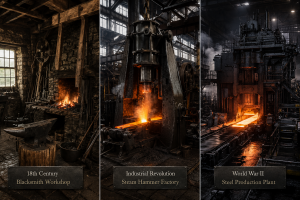
Iron Forging History represents one of the most important technological evolutions in human industry. From ancient manual blacksmithing techniques to modern industrial mass production, forging has been shaped by major global events such as the Industrial Revolution and World War II.
This transformation changed not only manufacturing processes but also global economies, architecture, and industrial development.
Early Iron Forging and Manual Production
Before industrialization, iron forging was performed manually by blacksmiths in small workshops. Using basic tools, heat, and hammering techniques, artisans shaped iron into tools, weapons, and essential construction materials.
These processes were slow and required high skill, limiting production capacity but ensuring craftsmanship quality.
The Industrial Revolution and Mechanical Transformation
The Industrial Revolution marked a turning point in Iron Forging History. With the introduction of steam power and mechanized production systems, forging shifted from manual labor to factory-based manufacturing.
The invention of steam engines and industrial machinery allowed mass production of iron and steel products, increasing efficiency and reducing costs.
- Introduction of steam-powered machinery
- Development of blast furnaces
- Mechanical and steam hammers
- Bessemer steel production process
These innovations enabled the creation of stronger and more complex iron structures used in bridges, railways, and industrial buildings.
Industrial Expansion and Urban Development
As production increased, iron forging became essential for urban expansion. Cities rapidly grew with steel-based infrastructure replacing traditional wood construction.
One of the most significant examples was Chicago, which rebuilt itself after the Great Fire of 1871 using steel and iron frameworks, leading to the rise of skyscraper architecture.
Iron components such as railings, staircases, and structural supports became fundamental in modern construction design.
Technological Innovation in Manufacturing
New forging technologies allowed factories to produce stronger and more durable materials. Press forging and mechanical forging systems improved precision and consistency in metal production.
These advancements supported industrial growth across Europe and North America, establishing iron and steel as the backbone of modern infrastructure.
World War II and Industrial Acceleration
World War II significantly accelerated industrial production. The demand for weapons, vehicles, and military equipment required mass-scale forging and steel manufacturing.
Factories operated at full capacity, leading to innovations in automation and production efficiency.
- Mass production of military equipment
- Advanced forging techniques
- Early automation systems in factories
- High-strength steel development
This period marked a major shift from traditional manufacturing to highly optimized industrial systems.
Post-War Reconstruction and Civilian Use
After World War II, industrial production shifted toward reconstruction and civilian development. Iron forging was no longer focused on military applications but on rebuilding cities and infrastructure.
Housing, transportation systems, and commercial buildings required large quantities of forged steel and iron components.
This led to rapid urban development and modernization across many countries.
Modern Iron Forging Industry
Today, Iron Forging History continues through advanced manufacturing systems that combine traditional forging techniques with robotics and automation.
Modern industries use high-precision machinery to produce durable and efficient metal components for construction, transportation, and security systems.
Despite technological advances, the core principles of forging remain unchanged: heat, pressure, and shaping metal into functional structures.
Conclusion
Iron Forging History shows how human innovation evolves through necessity and global change. The Industrial Revolution introduced mechanization, while World War II accelerated production and technological advancement.
Today, iron forging remains a fundamental part of modern industry, shaping everything from architecture to transportation and infrastructure worldwide.